


Impressions from the recent Learning from Leaders Event – Quantum Technologies and their Impact on Business

Do Quantum Technologies already have the potential to fundamentally impact our everyday lives? Will there be a "ChatGPT moment" with this complex technology? These questions, among others, were the focus of the latest 'Learning from Leaders' event on Quantum Technologies. We were pleased to welcome more than 50 guests to this event.
Quantum Technologies viewed from two perspectives
The Learning from Leaders event was designed to address all questions from an academic and a business perspective.
We were delighted to welcome:
- Dr. Judith Gabel – Experimental physicist at LMU and member of the QL3 – Quantum LifeLong Learning project, sharing her extensive research and teaching expertise.
- Dr. Alexander Glätzle – Co-founder and CEO of the start-up planqc, aiming to revolutionize quantum computer production and recently named to Capital Magazine’s Top 40 under 40.
- Moderator: Isabel Werdin – Her questions provided clarity and made the complex topic accessible to all participants, regardless of their background.

Will Quantum Technologies have a Breakthrough?
Comparing the development of Quantum Technologies with Artificial Intelligence or other disruptive innovations is challenging. Each technological field evolves at its own pace and experiences different “breakthrough moments.”
Whether a kind of “ChatGPT” moment will also arise in Quantum Technologies is still a question mark. A variety of factors such as hardware suppliers of quantum computers can slow down or speed up development processes. In principle, Quantum Technologies have the potential to revolutionize our everyday lives.
What Applications are there for Quantum Technologies?
Quantum Technologies are currently suitable for specific tasks but promise even greater advantages in the future.
Current and emerging applications include:
- Quantum Sensors:
Offering far greater precision than conventional sensors, with promising use cases in medicine for extremely precise measurements. - Quantum Computers:
Useful for simulating molecules and chemical reactions, highly relevant for materials research and the chemical industry.
However, they are not yet mature enough for large-scale, complex problem solving. Current use is limited to small experimental setups.
True “quantum advantage” has not yet been achieved.
Nevertheless, companies have the opportunity to acquire computing power on quantum computers in order to carry out initial experiments and explore the potential of this technology.

Closely linked: Business and research in the field of Quantum Technologies
Research institutions and start-ups are currently the key economic players in the field of Quantum Technologies, and particularly in the development of quantum computers. The latest developments in the field of quantum technologies are closely linked with the current state of research.
In Munich, both benefit from the Munich Quantum Valley, which brings research and practice together. In addition, the state of Bavaria promotes quantum technologies, which makes Munich an attractive location for start-ups in this field.
Networking and individual questions to the experts


We want to thank you for this successful evening and look forward to further networking opportunities in 2024.
Want to delve deeper into disruptive technologies?
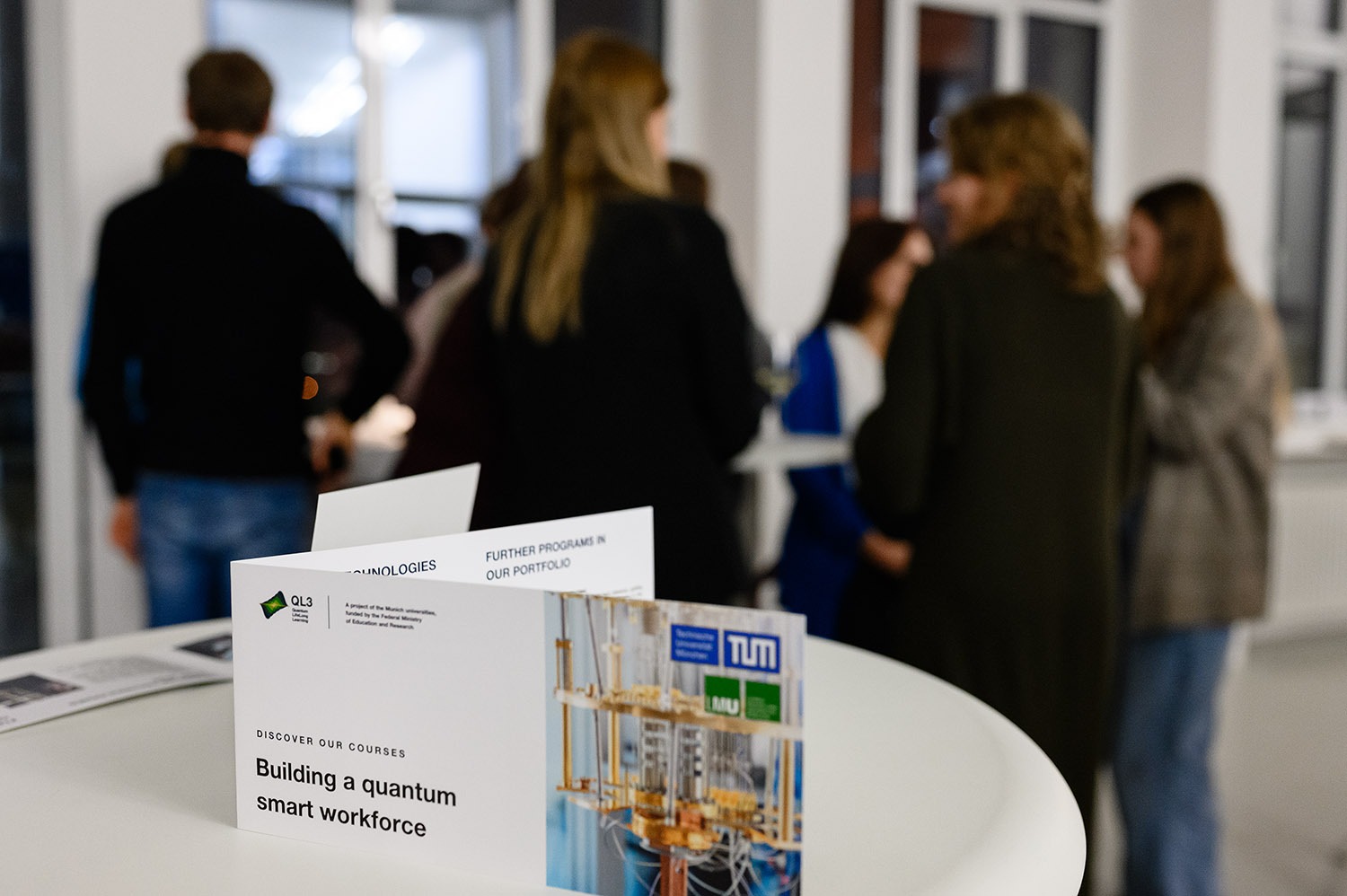
We offer technology programs that deepen your understanding of disruptive innovations and equip you with the skills to navigate emerging technologies.
All photos © Thomas Linkel

