
Urban Air Mobility
| Language: | English |
| Location: | Online |
| Duration: | Flexible, approx. 10 weeks |
| Start: | Anytime |
| Cost: | 45 EUR |

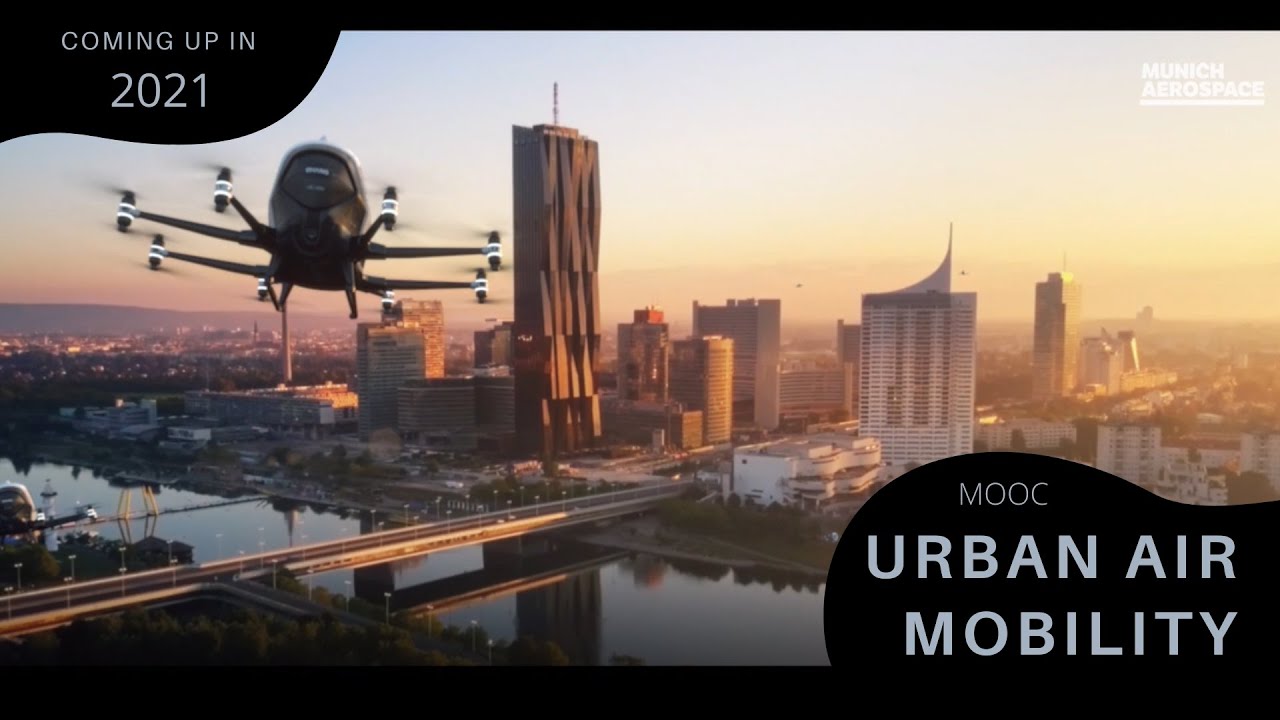
The course gives you a first introduction to the relatively new field of urban air mobility, explains the technical background and provides an overview of all other necessities such as air traffic management, public acceptance and environmental sustainability.
Benefits
01
1
New Subject Area
02
2
First-hand Know-how
03
3
Certificate from Coursera and TUM
Urban Air Mobility
Program Overview
Here you will find information on the aims of this course and its content.Here you will find information on dates, requirements and other general conditions for the certificate program.Program:
Target group:
Learners who are keen to explore new fields in Aerospace and want to understand the in depth concepts of new mobility and the influence of Urban Air Mobility on the entire transport system.
Format & Timing:
Flexible, self-paced, approx. 10 weeks when investing 3-4 hours per week
Provider:
TUM Institute for LifeLong Learning
Study location:
Online (Coursera)
Language:
Dates:
Admission requirements:
Basic knowledge of Aerospace science is beneficial.
Background in Aerospace and Engineering is a must and will make you progress faster.
Graduation:
After successful completion of the final exam, participants will receive a certificate from Coursera and the Technical University of Munich.
Program fee:
The program fee is 45 EUR. Access to lectures and assignments depends on your type of enrollment. If you take the course in audit mode, you will be able to see most course materials for free. To access graded assignments and to earn a Certificate, you will need to purchase the Certificate experience, during or after your audit.
Get to know our experienced lecturers who will teach you the certificate content and with whom you will work.Chair of Carbon Composites, TUM
Team Leader, Bauhaus Aviation e.V.
Aviation Management, University of the German Armed Forces
Civil, Geo- and Environmental Engineering, TUM
Civil, Geo and Environmental Engineering, TUM
Head of Pilot Assistance, DLR
Founder & Managing Director, Airbus Urban Mobility GmbH
Georgia Institute of Technology
Electrical and Computer Engineering, Concordia University Montreal
FAJ Bettini, Production Engineering Department (SEP) (Sao Carlos), University of São Paulo
Officer, The Federal Ministry of Transport and Digital Infrastructure
Find out how the program is structured and what content you can expect.This first course module gives an overview of all aspects that define “Urban Air Mobility”. It explains the concept of Urban Air Mobility as well as all crucial factors, such as vehicle and power train design, infrastructure and vertiport design, etc.
Module 2: Urban Air Mobility from an Industry Perspective
In this module, Dr. Markus May presents the approach to the topic of Urban Air Mobility from an industry perspective and shows the ideas of Airbus in this context.
Module 3: Political perspectives
In this module, the Federal Ministry for Digital and Transport presents the national policies and the legal framework for Urban Air Mobility in Germany.
Module 4: Demand Modeling for Urban Air Mobility
This module describes different approaches and data used to model travel demand. An introduction to discrete choice models is provided.
Module 5: Aviation Management
Decision makers at airports and airlines face many challenges and require support to deal with these effectively and appropriately. This gives rise to a variety of difficult and interesting problems. This module looks at three big classes of problems and discusses applicable general solution approaches.
Module 6: Traffic Management for Urban Air Mobility
This module is about understanding how traffic management for urban air mobility could work and what conditions need to be designed in an urban environment.
Module 7: Urban Air Mobility and Urban Planning
This module explains the common transport and land use planning processes that are required for building UAM vertiports.
Module 8: Understanding the Acceptance of Urban Air Mobility
This course covers a range of topics related to determining the demand for previously unavailable modes of transport, such as UAM.
Module 9: Air Mobility Trajectory Planning
Professor Rodrigues from Concordia University in Montreal presents the basics of trajectory planning, also, he describes how infrastructure, social acceptance, sustainability, flight data and air traffic management, as well as the regulation and certification serve as most important pillars in air mobility.
Module 10: Economics of Urban Air Mobility
This module discusses some of the economic conditions (cost, demand, finance) that must be met for market viability of eVTOL vehicles in passenger transportation networks.
Testimonials
-

The course was very intensive. It covered all aspects of urban mobility and related technical aspects. The professors, who are from reputed universities, made the chapters cohesive, conceptual and practical so that the students are able to understand the circumstances, past, present and future scenario of urban mobility in an industrialized environment.
Former participant of the course -
I really appreciate TUM’s efforts to improve the knowledge of people around the world through free education.
Former participant of the course
Partner

Munich Aerospace
-
Your contact
Vesna GajicPhone: +49 89 289 28474